
AI: Insights engine
my role
Product designer/Product owner
context
Synex Medical is building non-invasive health monitoring technology to support a future of predictive and personalized medicine. As the company explored how to surface meaningful health insights for users, we faced a key challenge: insight generation required experimentation across data modeling, metrics, and UX but the core software team was fully allocated to R&D and firmware priorities.
We needed a way to explore and validate health insights without committing engineering resources or introducing roadmap risk.
summary
I took end-to-end ownership of exploring and validating a potential insights engine. Rather than waiting on engineering availability, I designed and built a lightweight, low-risk pipeline that combined deterministic health metrics with an LLM layer to generate human-readable insights.
This work expanded my role beyond traditional UX into systems thinking, data modeling, and applied AI. By using off-the-shelf tools and carefully constrained AI outputs, I was able to unblock progress, enable real-world beta testing, and provide leadership with concrete evidence to inform future investment decisions.
The problem
We wanted to provide users with meaningful, holistic health insights by combining data from multiple sources. However, we had no low-cost, low-risk way to validate whether these insights would actually resonate with users.
Committing engineering resources too early carried significant risk. Insight generation required iteration and experimentation, but the organization lacked a safe environment to do that work.
I created one.
The workflow gap
Several constraints shaped the approach:
Core software team bandwidth was limited and focused on critical R&D work
Validating insights too late in the roadmap would introduce unnecessary risk
Insight generation required rapid iteration across data logic, UX, and language
Traditional development workflows were too slow and costly for this level of exploration
This gap presented an opportunity to use AI and lightweight tooling to move faster, independently and responsibly.
End-to-End approach
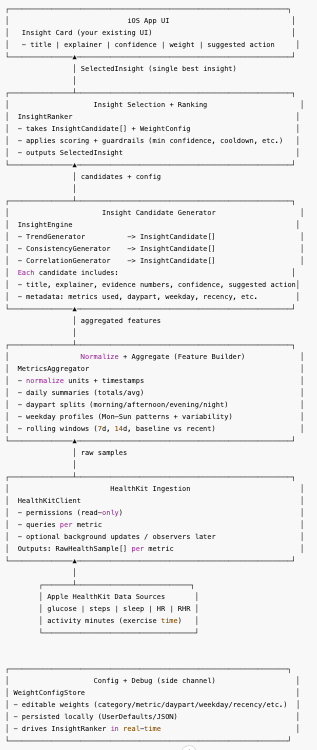
This project implements a modular insight pipeline that transforms raw Apple Health data into a single, high-quality, human-readable insights. HealthKit data is first normalized and aggregated (daily, weekday, and daypart), then passed into an insight engine that generates multiple insight candidates (trends, consistency, correlations). A separate ranking layer scores and selects the best candidate using configurable weights, confidence heuristics, and bonuses, allowing the UI to remain stable while the intelligence underneath evolves.
In short it:
Separates data ingestion, aggregation, insight generation, and selection
Generates multiple candidate insights, not just one output
Uses a transparent ranking layer (not free-form AI generation)
Supports incremental addition of metrics and insight types without UI changes
Why This Pipeline Worked
This architecture was intentionally designed to be safe, auditable, and fast:
Avoids hallucinations by using structured templates and exact numerical evidence
Makes insight selection explainable and debuggable
Allows safe experimentation through weights, bonuses, and future cooldowns
Scales from prototype to production without re-architecting the system
The UX behind the health insights
Principles
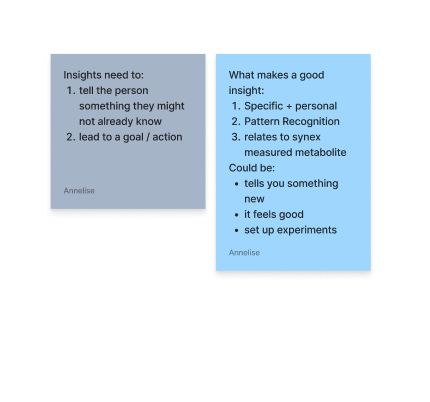
Through multiple rounds of research I identified four core principles for delivering health insights to users.
Insights should align with how people naturally reason about their health
Emphasize patterns over isolated data points
Each insight should answer a question users already ask themselves
Insights must be trustworthy, clear, and emotionally responsible
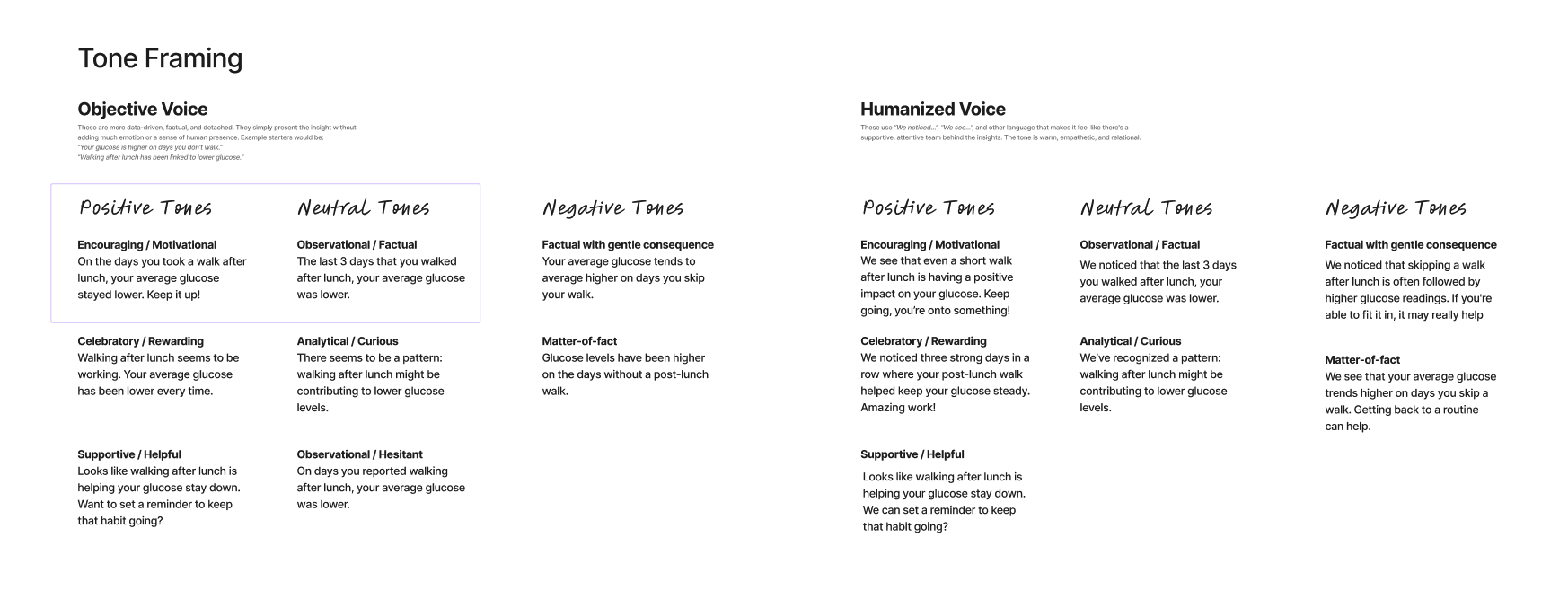
Human Language Matters
Human language bridges the gap between metrics and meaning. The LLM layer was carefully constrained to ensure insights remained accessible, non-clinical, and grounded in real data—while still feeling human and understandable.
Health insights can evoke strong emotional responses, making clarity and tone as important as accuracy.
Impact
This work enabled confident decision-making before major investment:
De-risked a new insights product direction
Provided leadership with concrete evidence to inform roadmap and resourcing decisions
Created a reusable metrics and insights framework
Enabled early beta testing with real user data
Unblocked progress without adding load to an already maxed software team
This project reflects how I operate at a Staff level: identifying organizational bottlenecks, expanding my skill set to address them, and using AI thoughtfully to increase speed, confidence, and leverage.